


Mar
There are probably as many ways to approach running a marathon as there are people who have run one! We’re all different, will have trained differently, and have different goals. That said, there are a few solid principles, and some tried and tested tips that will help you get the most out of yourself and run your best marathon.
(nb: We don’t consider it a given that your fastest marathon is your best marathon. You could make loads of mistakes, but still run quickly, depending on the weather, course, or other factors. Instead, we consider your best marathon to be one in which everything went right and you finished feeling proud of your achievement, regardless of the finish time.)
During marathon training
Get specific with your training and make sure you cover everything before race-day. You shouldn’t simulate the marathon on every training run, but aim to tick off the following at least a few times in the weeks beforehand:
- Wear your race shoes and clothing so you know that it’s all comfortable.
- Practice race-weekend nutrition: rehearse your night-before meal, race-day breakfast, and gels or other energy sources during the run.
- Run at the right time of day. If you’re usually an evening runner, make sure you get used to morning runs.
- Do some of your training at target race pace if you have a goal time in mind.
The days before the marathon
You can’t cram any more training in just before a marathon, so the aim in the last few days is to make sure you don’t undo all your good work.
- Eat food that isn’t going to cause you any gut issues on race day.
- Avoid getting ill, by practicing good hygiene. And wear shoes in the kitchen, to avoid a dropped jar or knife causing an injury.
- Try not to spend energy unnecessarily. Those ‘world record pace’ treadmills at some marathon expos are fun, but high risk.
- Get everything ready beforehand. Keep a checklist of the kit you need to remember.
- If your preferred food or drink options are tricky to find, make sure you travel with everything you need, rather than rely on local shops.
- Plan your route to the start and decide on a location to meet your friends and family after the race.
- Travel with ear plugs and an eye mask, in case you end up in noisy accommodation.
Marathon morning
Minimise stress, wherever you can.
- Be selfish. If possible, only focus on getting yourself ready. You don’t want to miss the train to the start because you got waylaid helping your other half find their keys or convincing a toddler to eat their breakfast.
- Allow loads of time to get to the start. Roads will be closed and public transport will be busy, so get ahead of the rush.
- Carry toilet paper and hand gel, as you can’t rely on portaloos being well-stocked.
- If you don’t need to be standing, sit down and save your legs.
Starting the marathon
The opening ten kilometres of a marathon is where you should aim to settle into a good rhythm.
- Starting too fast need not lead to disaster, provided you promptly ease off and correct your pace. The problems arise if you run too fast, for too long: you might feel OK for a while, but you’ll probably pay for your early enthusiasm towards the end of the race.
- The first few drinks stations will be busy, as the pack won’t have thinned out yet. Keep your wits about you, avoid cutting across anyone, and don’t panic if you have to miss one or two (there’ll be another opportunity in a few km).
- Pacemaker runners, often with banners or balloons, are a great visual marker to keep you on pace. However, they usually attract a big crowd of runners around them. Don’t be afraid to hang back: you can still keep the pacer in sight, but are likely to have more space to run your own race.
The middle of the marathon
A marathon is an exercise in energy and effort management, with the best results often arising from running at an even pace, especially through the middle half (around 10 to 30 km).
- Run each mile or km split as evenly as you can. Bear in mind, GPS signals can be inaccurate in built-up cities and you can’t trust your watch, so consider hand-timing your splits by hitting the lap/split button at each mile/km marker.
- Staying cool can use a massive amount of energy. Help your body out by sticking to the shady side of the course (unless it means running further) and tipping water over yourself at each drinks station to cool down.
- Stick to your fuelling strategy to keep your energy up.
- The middle section can be tough, psychologically, as it can feel boring (“I’ve been running for ages…”) or intimidating (“…but still have so far to go”). Stay focussed on your race strategy, but also think about things that make you feel happy. Some runners like to dedicate each mile to a different loved one.
- Slot in behind someone running the same pace as you, and use them as your own personal pacemaker. If they start to speed up, let them go. If they slow down, move on past and pick a new runner to follow.
- Check in with your body periodically: relax your shoulders, shake your arms out, and make sure you’re still holding good running form.
- If you feel like you can speed up, don’t! Resist the temptation to increase the effort now, as there’s still a long way to go. Instead, hold onto that thought and save it until the last few miles.
Finishing a marathon
If you’re trying to get the most out of yourself, and run a marathon as fast as you can, then the last 10-ish km are going to be tough, but there are still things you can do to run your best.
- Smile: it can make a massive difference to your mood and make running feel easier.
- Tell yourself, “It’s supposed to feel like this.” Unexpected pain can cause us to panic, but our bodies are remarkably good at dealing with pain and discomfort when we expect and understand it. When your legs start to ache, or you begin to feel tired, remember that this is entirely normal and to be expected. Frame the discomfort as a good thing to be embraced and celebrated as a fundamental part of marathon running. You can even get specific: “I’m 35km into a marathon: my legs are supposed to ache.”
- We’re also good at dealing with pain if we know when it’s going to end. Counting down the likely time remaining can make the pain easier to manage: “Just 25 minutes remaining,” etc.
- If you’ve been following a pacer at a distance, and still feel pretty good, then now is the time to gently increase your effort and try to catch them up. Use them as a target and imagine that you’re reeling them in. There’ll be other runners slowing down, so you can use them as targets too: catch one, move on to the next, and work your way up the field.
- (Alternatively, if you’re struggling, imagine you’re being chased, hold on for as long as you can, and make it your goal to minimise the number of people who come past you.)
- When you can see the finish, pump your arms and give it everything you’ve got.
Putting it all together
For most runners, the ideal way to pace a marathon is with a very subtle negative split, whereby the second half is slightly quicker than the first. But that doesn’t mean you should immediately speed up once you hit halfway. Instead, it’s better to stay as close to your target pace as you can, for as long as possible, and then use the last of your energy to speed up only once you get close to the finish.
As an example, imagine you want to finish a marathon in under 5 hours…
This will require running 11’27/mi or 7’06/km and it would be great if there was hardly any deviation from that pace for at least the first three quarters of the race. Start behind the five hour pacer and settle in behind the group with enough space around you to avoid dramas at the drinks stations. Use the pacer as a marker, but also keep an eye on your own splits. Don’t panic if your pace fluctuates a little, but try to stay as steady as you can.
Keep your energy topped up, and stay cool by chucking water on your head. Aim to hit halfway as close to 2:30’00 as you can. It’s not a problem to be a little slow at this point. As the race progresses, accept any discomfort or pain that arises (it’s to be expected) and stay smooth. Shake the tension out of your shoulders at every distance marker.
Once you get down to around 45 to 60 minutes of running remaining, this is when you can speed up ever so slightly. Make a note of how far ahead the pacer is, and try to get closer, going past the stragglers falling off the back of the group.
In the perfect scenario, you’ll catch the pacer just before the finish comes into sight (for the London Marathon, this would be somewhere between Big Ben and Buckingham Palace). Then, as you come round the final bend, sprint as hard as you can, get ahead of the pacer, and throw your arms into the air as you cross the line and celebrate your 4:59 marathon!
The secret ingredient for success
Our final piece of advice is:
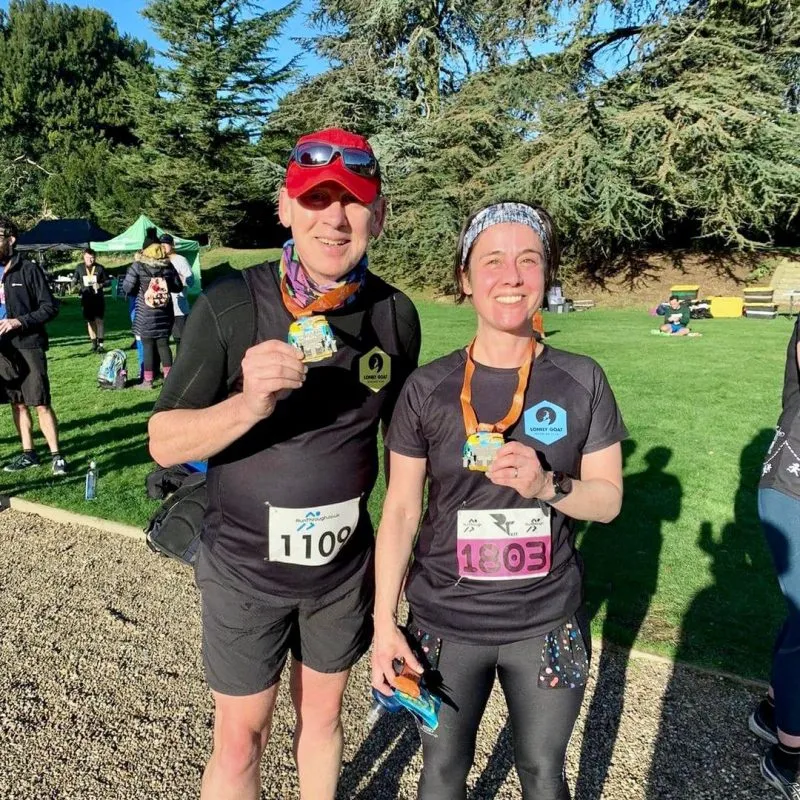
- Wear your Goat kit and, at almost any race, you stand a good chance of having at least one runner or spectator give you an encouraging cheer! This could give you a perfect boost just when you need it.
Enjoy your marathon, and let us know how you get on – or share any tips of your own – in our Strava Club, Facebook Chat Group, or by tagging us into your Instagram posts.
+++
Further Reading:
More marathon advice…
- Running in the heat – tips from the Herd
- The alternative pre-marathon checklist
- Do I need to eat during a marathon?
- How to train for a marathon